
Growing up Kumbh was a cliche for me. I have roots in both
To give you an idea of how close we are to it, the name Kumbh Mela is too formal for our household – for us, it is Kumbh, just Kumbh. ‘Hum Kumbh nahane gaye the’, literally, ‘I’d gone to bathe in the Kumbh’, is how you would hear one of us talk.
Over the last 18 months I have found in me a new urge, which compels me to experience the world and its events far more deeply. So the Kumbh Mela wasn’t one I was going to miss.
I am also a city slicker and so I was dying to know what this hype was about. At the risk of sounding cliched, I am not particularly religious, so that was definitely not the driving force.
And despite all the sins I have committed, I wasn’t looking to wash any of them away either. That said, little did I know what was in store for me. A quick reckoner on what the Kumbh is:
The Kumbh Mela happens once every four years at one of the four designated sites – Prayagraj, Ujjain, Haridwar or Nashik. The site is shortlisted based on planetary positions and their alignment.
It is believed that a dip in the holy river cleanses one’s sins. The river of the city where the Kumbh is held is believed to turn into Amrit during the Kumbh, allowing devotees to bathe in its pureness and immortality.
As per Hindu mythology the Kumbh is the pot that was used by the Gods and the Asuras to collect the
A fascinating aspect of the Kumbh is that the places hosting these grand congregations are small towns and cities. What I am getting at is, smaller towns or cities that are perhaps slow, if not sleepy, transform during the Kumbh into a pulsating sea of humanity.
To give you an idea, the population of Allahabad is just over a million. This year the number of visitors at the Kumbh ranged from 140-240 million over the 49 day period.
Kumbh had a celebratory air that drew me in even before I stepped foot in Prayagraj. On the morning of the snan, or the dip, I remember the utter quietude that belied the glorious chaos that was about to unfold.
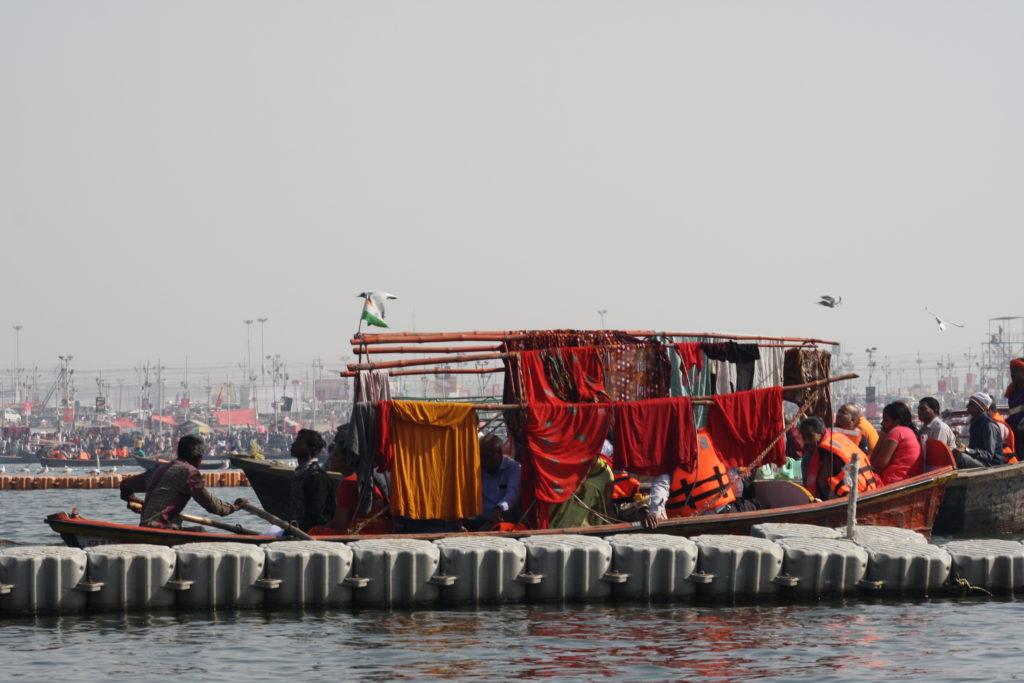
Within a few moments of sunrise, the Triveni Sangam was speckled with colours that no palette could imagine. From the chiming of the mantra of ‘Har Har Mahadev’ being sung in praise of Lord Shiva to the raucous screams of the boatmen, who were gathered in their hundreds, nearly causing a traffic jam on the holy river.
How quintessentially Indian it all was! My favourite memory is trying to get to the Sangam by hopping over more boats than I cared to count.
Finally it was the moment of reckoning. Being hydrophobic and claustrophobic, it was not my most courageous moment. To add to that the water was so cold, it felt like it seeped through my flesh and froze my bones.
But this was a fraction of a second. From not wanting to take a dip, to the moment of joining hands that formed a human chain and taking umpteen dips (one dip for each prayer that I had in mind), the moment was almost surreal. And guess what, I had conquered my phobia, if only momentarily!
Of course it helped hugely that the river wasn’t filthy and the arrangements were top notch. They even had a Jal Police (River Police), just FYI. The safety measures imposed were impressive – for instance, the mandatory use of lifejackets, limiting the number of people per boat etc. Was this really U.P.?
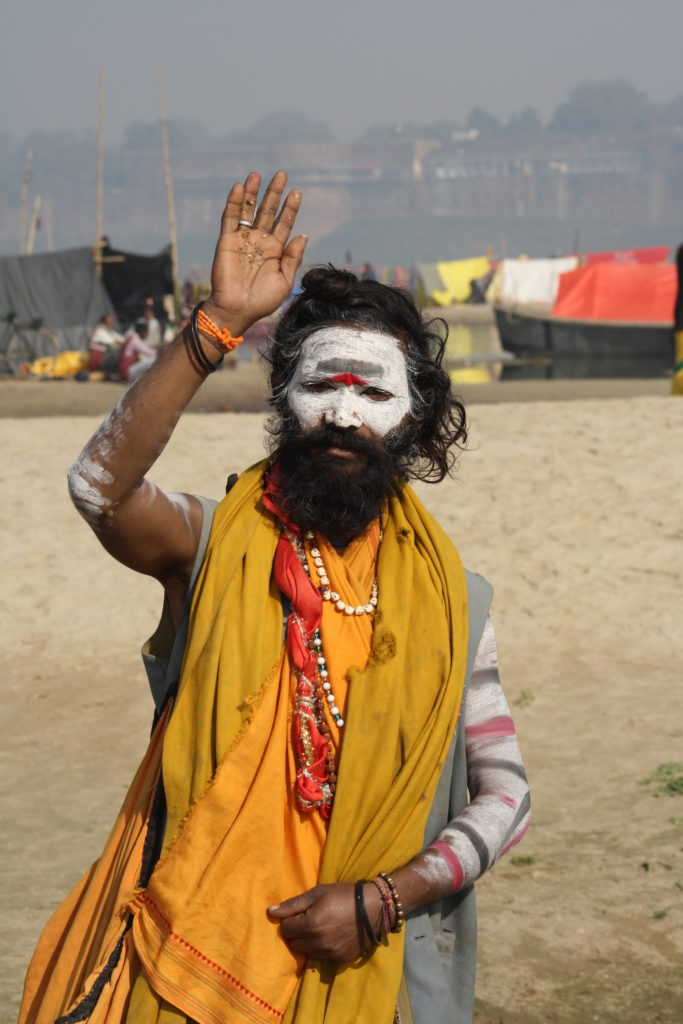
I was also fortunate to visit the many Akhadas and meet Babas, including the Aghori Babas (the babas notorious for walking in the nude and having ash smeared all over their bodies).
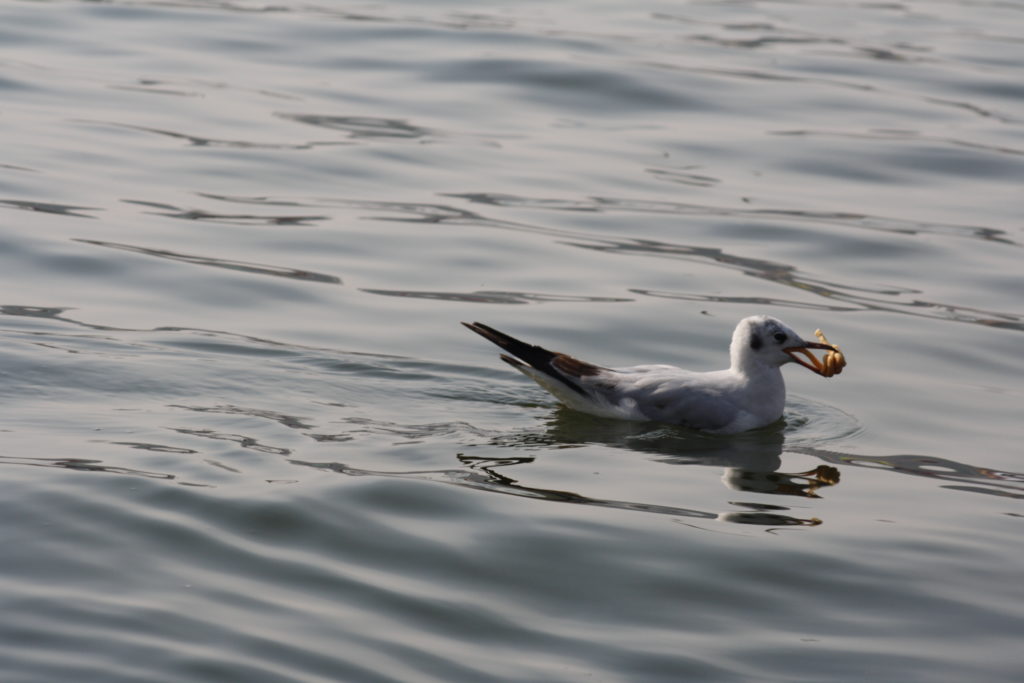
Everyday that I was here was a new experience. Watching the sun rise and set over the sea of hundreds and thousands of tents that were famously called the ‘tent city’, to watching little things like yogis hanging upside down off tree branches, to seeing the migratory birds that gather up the river and surprisingly have an appetite for the local savouries. Imagine that, a black headed gull with a taste for good old Indian deep fried gathia (savory).
In the words of author and columnist Gautam Chikermane,
“Not rituals — Kumbh gave me a window to look at the vastness of India, its people, it’s Oneness.
Not rides — Kumbh gave me eyes to look within, to see the beyond, to become part of the whole, merge into our civilisation.
My discovery:
You are Kumbh.
I am Kumbh.
We are Kumbh.”
Looking back I feel fortunate that little ol’ me had the opportunity to be a part of a larger whole. Some reports claim, as many as 50 million (5 crore) people participated in the shahi snan on one day!
I missed that of course but am not surprised that Kumbh is therefore recognized by UNESCO as an Intangible Cultural Heritage of Humanity. And, as I learnt this year, that is no hyperbole. I’m certain I’ll be back for the next Kumbh. It is now a part of me.