
He was celebrated for his liberal stance, generosity, and knowledge, among other things. He was also famous for his secular outlook. A true leader, he worked to ensure his empire was an inclusive one. To preserve the unity of his empire, he even implemented programmes that helped win the trust of non-muslims. Among other things, this ruler loved books despite being illiterate himself. Yes, this is the story behind Abū al-Fatḥ Jalāl al-Dīn Muḥammad Akbar, the man the world knows as Akbar the Great.
A story goes that as a young prince, Akbar skipped attending his astrologically-auspicious tutoring session. And this was what left him illiterate for life. But it did not hamper his lifelong thirst for knowledge. At the time of his death Akbar was known to have had a library that was stacked with books. He had learned men in his court who were given the responsibility of translating, while others were given the key task of reading the books aloud to him.
In addition to all this, Akbar is also known to have been fascinated with construction and architecture. Numerous structures in Agra were built by him – including Fatehpur Sikri, Agra Fort, and many other palaces. Though it might seem a little odd, it was in his lifetime that he commissioned the construction of his own tomb. He envisioned it as a resting place not just for himself, but for generations of Mughals. However, as fate had it, Akbar passed away while the construction was still underway. The monument was later completed by his son, Emperor Jahangir around 1612.
More about the tomb and architecture:
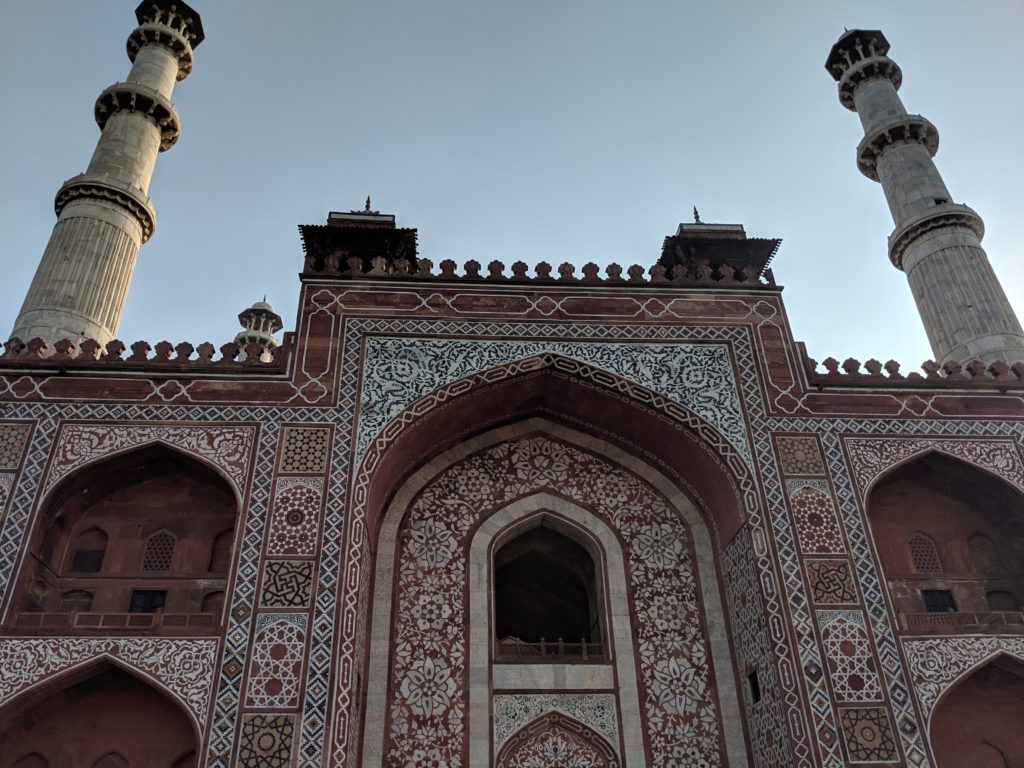
A large gateway, said to have been built to resemble the grand Buland Darwaza of Fatehpur Sikri, is what leads you to the structure where Akbar was finally laid to rest. Built from red sandstone, the gateway is laced with marble inlay displaying geometric patterns and floral motifs. The patterns, so intricate and beautifully carved, give an impression of print on paper. Inscriptions in Persian embellish the gateway. These sings praises of the reigning emperor Jahangir and mention the name of the calligrapher.
Upon passing the main gateway, you are greeted by large lawns. The mausoleum sits amidst the green lawns or the Char Bagh – a representation of the paradise garden from the Quran. The lawns on either side of the main tomb are inviting to say the least, with beautiful trees and fauna. Look out for the blackbucks, peacocks, and, langurs that bring life to an otherwise solemn tomb. As typical of Char Baghs, a water channel runs through it. The narrow water channel has high terrace like structures on either sides, each with a fountain. High walls enclose the garden. Each wall is embellished almost with a gateways of its own.
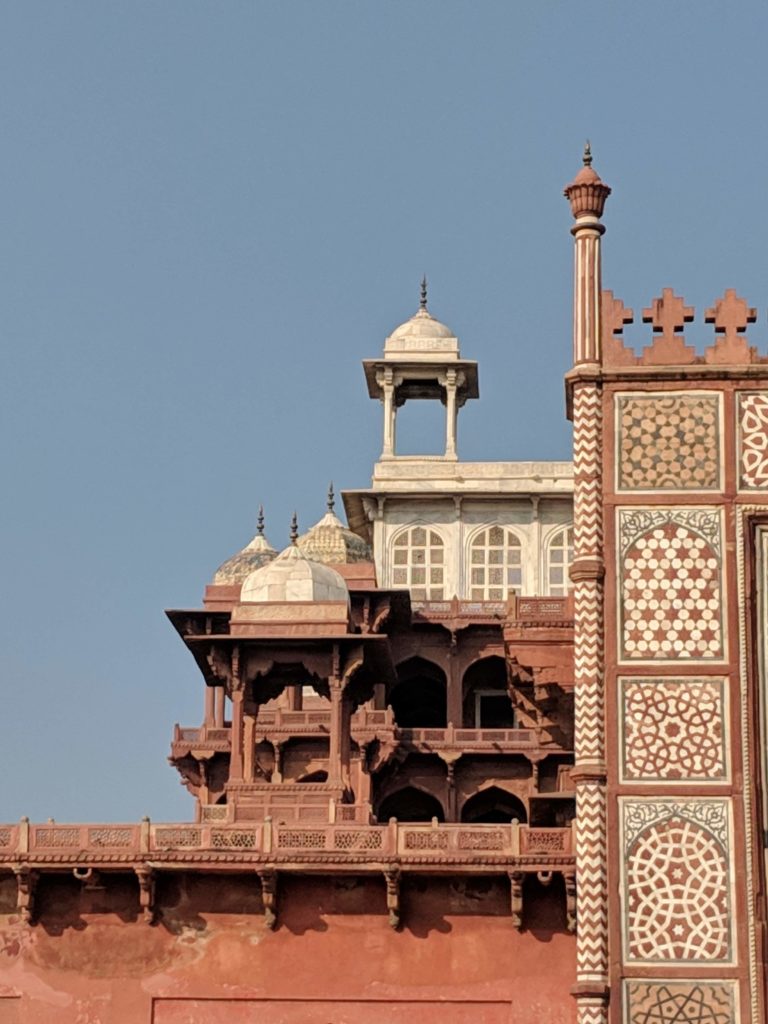
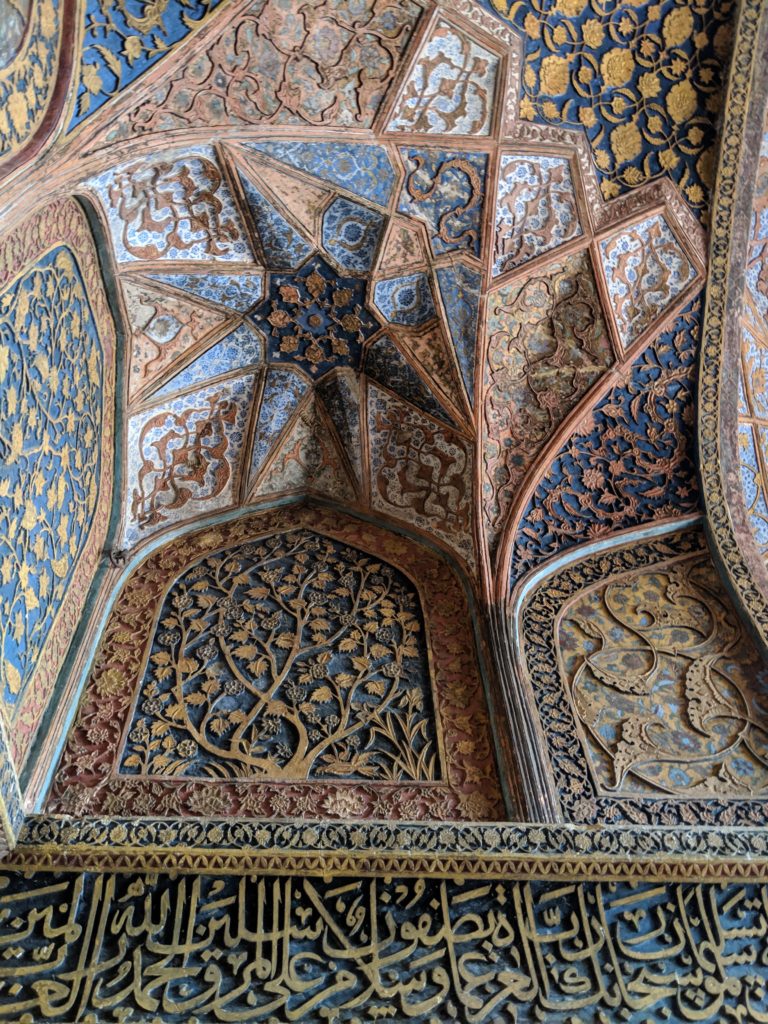
The entrance to Akbar’s tomb lies at the end of the walkway. Though conceptualized as a sandstone structure, this pyramid like building has white marble work on its top floor. Numerous chatris made from marble are seen adorning the roofs here at various levels. The main dome is squarish in shape. The entry to the main cenotaph, which houses Akbar’s tomb is also elaborately decorated with stucco work and painting in blue and gold. Gorgeous gold leaf motifs hint at the importance of this place – an Emperor’s tomb. A narrow passage leads one to the basement area, where Akbar the Great was laid to rest. You will notice that the room, which contains his remains is rather plain.
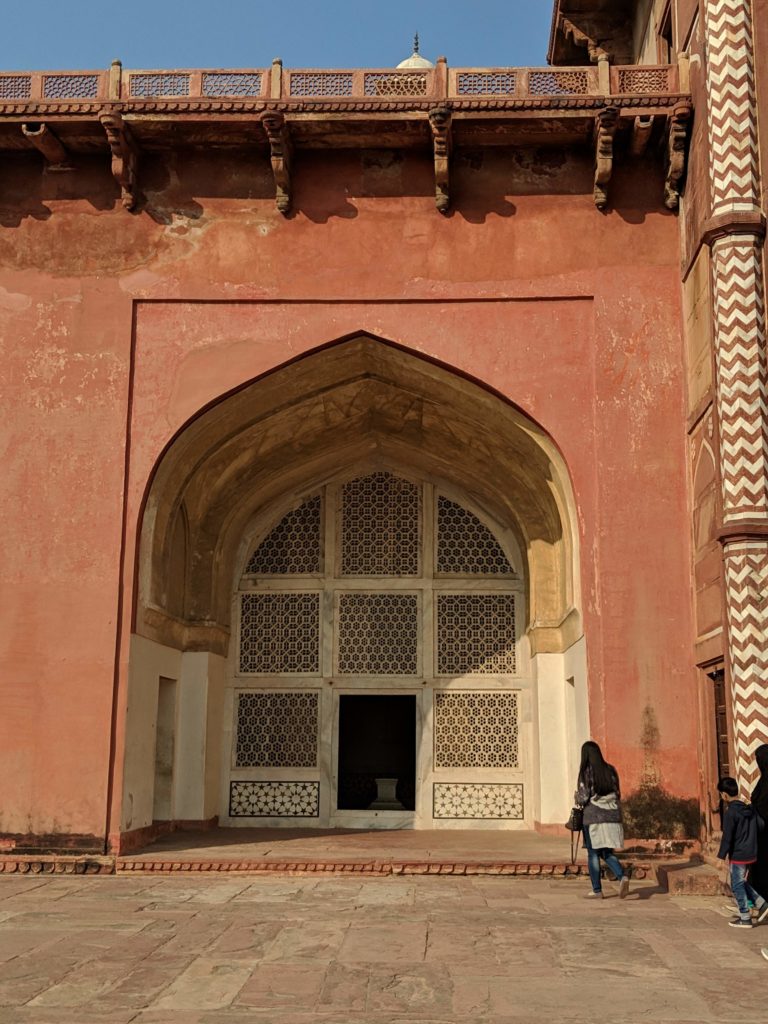
However, this isn’t how it is believed to have been from the beginning. Historians claim that during an invasion by the Jats, the tomb was looted. They even go on to say that so bad was the plundering that Akbar’s tomb itself was opened and his remains exhumed and disposed off. Whether there is truth to this or not, one cannot be certain. However, one thing we can be sure of is this: visitors are not expected to offer money at the tomb. So, if encouraged by a tout, please refrain from doing so. On your way out, do take note of the beautiful lattice work on the doorway.
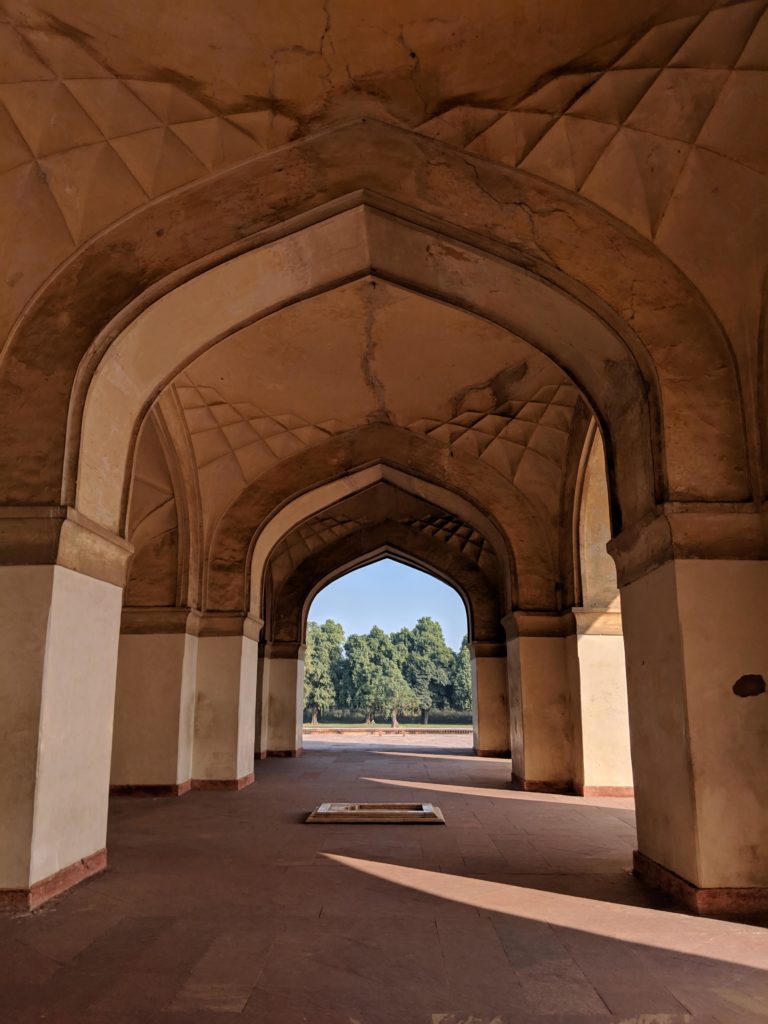
The ground floor of this magnificent structure is also flanked by numerous arches. An interesting feature of them being that they bring alive the hindi saying of ‘Deewaron ki bhi kaan hote hain’ i.e. even walls have ears. Try this: stand facing one of the columns, and have one of your friends stand facing the column diagonally opposite to you. Now whisper something. You’ll see that your friend can hear you clearly. This is the magic of great Mughal architecture.