
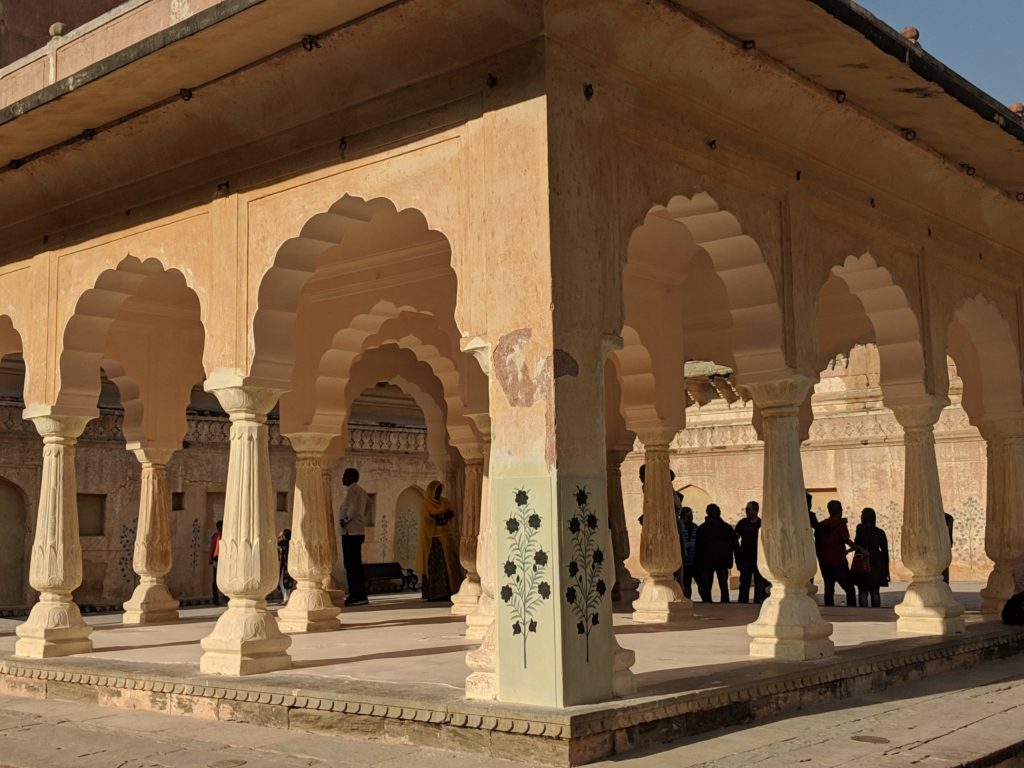
The concept of impregnable is redefined by this fort, the former home of the Kachwaha Rajputs. Built on a gorge amidst the Aravali hills, overlooking the man-made lake of Maota, Amber or Amer Fort as it is popularly known has seen the rise and fall of this dynasty over many centuries. And though this was their capital for close to 700 years, Amber was eventually deemed unfit. This, primarily due to the shortage of water that the town faced. So, the year 1727 saw the construction of a new palace and city for the Royal Family under the rule of Maharaja Sawai Jai Singh II.
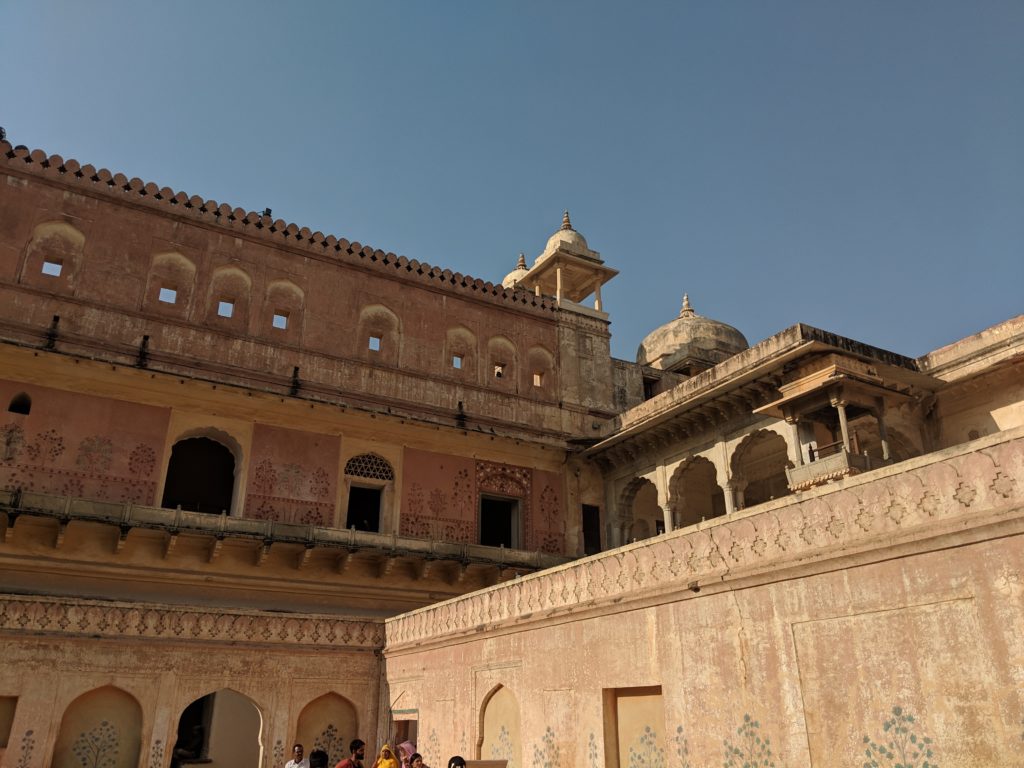
If you want to experience royalty, Rajput-style, how about taking the elephant ride to the top, much like the rulers and their royal guest did for hundreds of years. As you make your way up into the fort, you are welcomed by the sounds of the quintessentially Rajasthani folk song ‘Padharo Maare Des’ literally, ‘welcome to my country’ played on the Ravanhatta.
As you enter the courtyard, which once saw parades, and walk up further into the main complex, you can see a shift in the style of architecture. A splendid blend of Rajput and Mughal architecture, the fort that has one of the most unassuming exteriors, contrasts it by one of the most luxurious interiors in Rajasthan. From the awe-inspiring Sheesh Mahal, to the inviting arched gateway of Ganesh Pol, the fort of Amer is a living testament to one of the most illustrious Rajput dynasties, the Kachhwahas.
The famous Bollywood movie Jodha Akbar has also been shot here.
The architecture of the fort
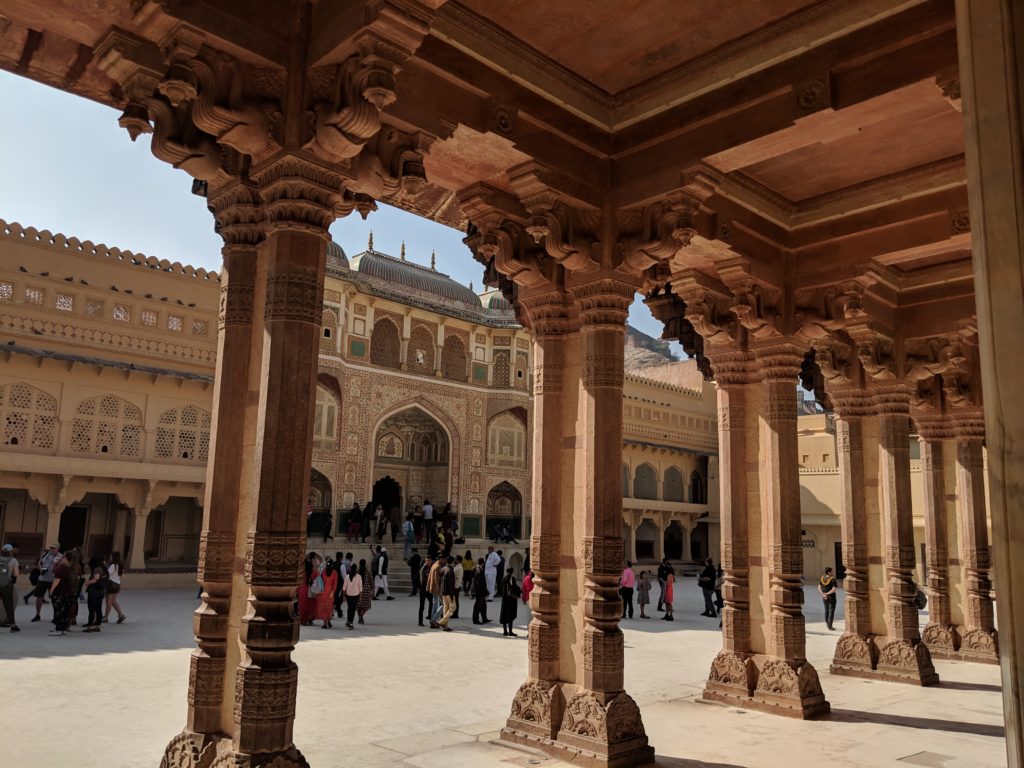
Like most other structures in Rajasthan, the Amer Fort is a blend of Mughal and Rajput style of architecture. Though it is safe to say that the fort of Amer brings alive this amalgamation in the most beautiful manner. It is believed to be built according to the Hindu system of Vaastu Shastra.
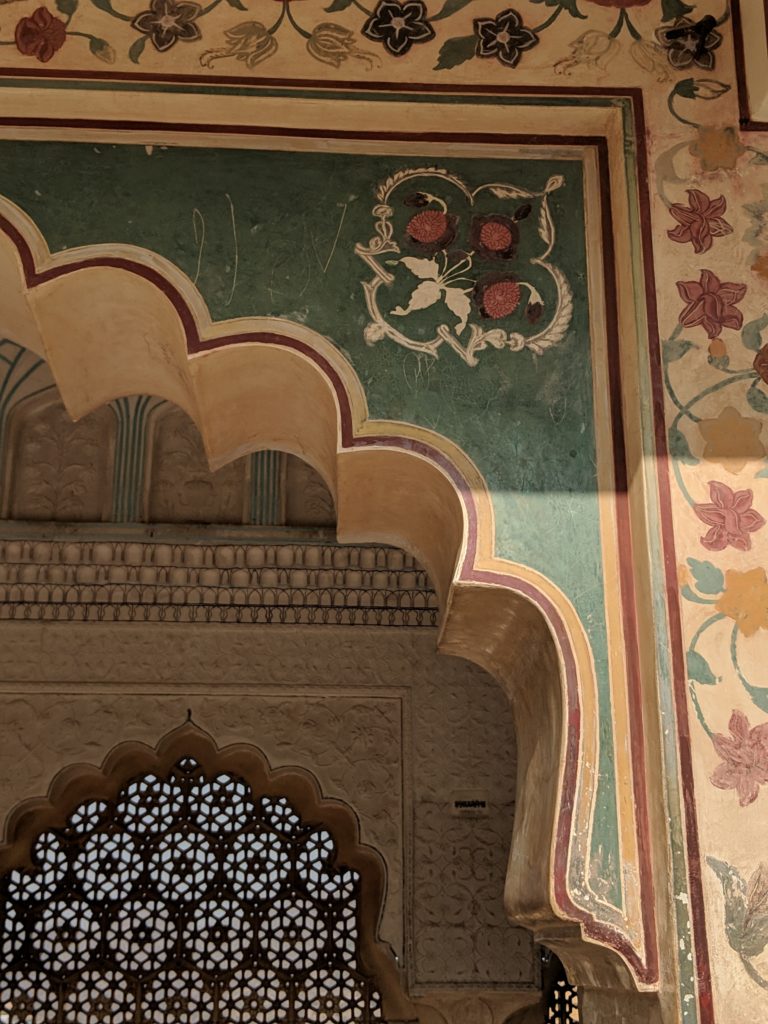
Built from sandstone in shades of red, yellow, and pink, the fort is divided into four main sections. Each section standing true to its own purpose. But did you know that the entry inside the complex was restricted depending on the status or the rank of the person? Only members of the Royal Family and those close to them had access to some of these areas.
So had you been a regular visitor to the fort in those days, your entry would have perhaps been limited to the Jaleb Chowk and the delights to the likes of Sheesh Mahal would have forever remained a mystery, stories of which you would hear only from those who had the privilege.
Amer fort was home to the Kachchawas for over six centuries.
Points of Interest inside Amer Fort
Suraj Pol: The more elaborate of the two entrance gates is the Suraj Pol. It is believed it gets its name from the first rays of the rising sun that fall here, illuminating it. The other reason perhaps being that the Royal family were Suryavanshis i.e. they believed themselves to be the direct descendants of Lord Rama. It was possibly due to this that the gate was named so and why the King preferred entering through this very gate. When the king entered through this gate, drummers would play music to welcome him.
While his public was allowed to enter through the other gate, the gate you’d take if you came up by car. This is the Chand Pol or the moon gate and it faces west.
Jaleb Chowk: The name mustn’t be confused with the Indian dessert jalebi. Instead, Jaleb chowk borrows its name from a Persian word, meaning soldier square. This chowk is an open air courtyard. It was here that after war the army would come back and convene to celebrate victory. Since the women maintained pardah, they would witness the celebrations from behind the veiled windows. Loud music from beating drums and other instruments, dance performances and an atmosphere of joy would fill this chowk on those days.
Read about
Horse stables can also be seen to one end of this chowk. These were well ventilated. It is said that the kings had a variety of horses – Arabic, those from Marwar and the other from Kutch. Each serving a different purpose.
It is believed that the post the royal family’s exit the base of the Jaleb chowk had seen numerous changes. From red oxide, to a garden, to what is today back to being a parade ground.
From here, one can see the palace of Harku Bai, the Mughal Emperor Akbar’s first Hindu wife, who is often known as Jodha.
Shila Devi Temple: Dedicated to Goddess Durga, the most fascinating feature of this temple are the silver doors. Said to be roughly 70 kgs of silver, the workmanship is exquisite. Seen above these doors is an idol of Lord Ganesh made from Coral, one believed to be the largest single piece coral structure and is roughly 5 kgs.
Diwan-i-aam: This was the public hall, where the king would address his people and their grievances. Since women weren’t allowed to be here, the jaali work helped them participate without being seen.
Ganesh Pol: From here, the King would pass through the Ganesh pol to go through to his palace. It is believed that to greet him, his Queen would stand on the higher floor and anoint him with flowers to welcome him. The gateway filled with fresco work is beautiful and elaborate with a blend of Hindu and Islamic style of architecture.
Corridors: For the construction of parts of the palace, it is said that limestone was mixed homegrown ingredients like Multani mitti or fuller’s earth, lentils, jaggery, rice powder etc. This would help reflect light off the smooth surface, thereby illuminating the entire walkway.
Sheesh Mahal: Built from numerous tiny convex mirrors that cover almost every bit of this palace, including its ceiling, is the Sheesh Mahal or literally the Mirror Palace. It is believed that this palace was built for the Queen, to give her a feel of sleeping under the stars. Two candles are said to have been enough to light up the entire palace and make it twinkle and resemble a night under the stars.
The reason for the construction of this beautiful palace is also believed to be to provide a warm room for the king to sleep in during winters. The light that would illuminate the palace, also ensured it stayed warm.
Beautiful designs envelop the entire hall, which is made from marble and stone. The numerous arches and pillars display beautiful intricate work both in marble and in-lay. Do look out for our video on the flower and the various elements hidden within it. Another fun experiment to try here is to light up the torch on your phone camera and point it towards the ceiling. This is sure to give you a glimpse of how the illuminated palace looked.
Hamam: A Turkish bath system, it had provisions for both cold and hot water. It is believed that water would come here through water tanks that maintained water temperature by having copper plates at the bottom. In summers, water flowed over the marble surface, thereby cooling the water’s temperature further. The water would reach these marble baths, mixed with mild fragrances and flowers that perfumed the bath and made it fit strictly for royalty.
Sukh Niwas: This is believed to be the palace of the Maharaja. The name suggesting peaceful place. The palace was kept cool by apparently
Man Singh Palace: Said to have 12 queens and a sharp King, Maharaja Man Singh is known to have commissioned corridors that led from his quarters to the different rooms of his queens.